
I teach parents how to educate their own children (especially those with struggling learners) so that they can successfully and peacefully homeschool or provide supplemental education at home. This podcast will discuss: - various learning disabilities and challenges, including: ADHD, dyslexia, autism, processing disorders, and so much more! - how all people learn - different learning styles - strategies for supporting specific learning challenges - how to apply these learning strategies at home - stories from homeschooling parents -interviews from other experts
Episodes
Feb 8, 2021
Feb 8, 2021
20 min
Bribes/ Rewards/ Punishments/ Sticker Charts are NOT a good way to motivate kids to learn!
Learn why and learn what to use instead!
Feb 1, 2021
Feb 1, 2021
28 min
In this episode, learn some perhaps surprising truths about common core!
(and why it isn't the enemy!)
Jan 25, 2021
Jan 25, 2021
11 min
In this episode, we will briefly cover the various psychological processes that may cause a learning disability if they are weak:
- Phonological
- Auditory
- Visual
- Attention
- Cognitive
- Sensory Motor
We will also discuss:
- Dyslexia
- Dysgraphia
- Dyscalculia
Jan 18, 2021
Jan 18, 2021
16 min
Of course, this topic is way bigger than we can cover here, but we’re going to go over some of the most critical and foundational elements to learning. Includes what makes a child:
- ready to learn
- engaged
- learn the "best": when, where, how!
Jan 11, 2021
Jan 11, 2021
23 min
video version of this episode at http://www.YourParentHelp.com/podcast_0102
notes download to accompany this video (and make it easier to follow along!): https://www.yourparenthelp.com/notes0102
Some Myths:
#1: there is a right way
#2: 1 person/entity is responsible
#3: Children need a "reason" to learn.
#4: You need to know your child's particular learning style.
#5: Children will naturally learn everything.
Jan 4, 2021
Jan 4, 2021
12 min
This episode covers:
- Who I am
- The goal and purpose of this podcast
- Some of my core beliefs
- The topics of this podcast
Dec 30, 2020
Dec 30, 2020
3 min
View original video at: www.YourParentHelp.com/videos
Okay, so I’ve repeated those statistics and I’m going to repeat them again:
We learn (can recall after 2 weeks) about 10% of what we read. 20% of what we hear. 50% of what we hear and see. 70% of what we say. And 90% of what we do!
Acting out what our child has read helps them to process what they have read, to learn it better, to understand it more deeply, and to feel it in their whole body. So much synaptic action happening in this strategy!
Dec 30, 2020
Dec 30, 2020
3 min
View original video at: www.YourParentHelp.com/videos
Almost every child I’ve met over about 7 years old has some dream or desire to be a You-Tube star.
Using our children’s interests helps them to be invested in their own learning. So if your child is like so many others and YouTube is an interest, make them a YouTube channel (or pretend).
They can create a video review of the book they have read, telling the viewer all of the most important bits, except maybe the surprise ending!
Again, we remember about 70% of what we say, so this is really solidifying that book into their memory.
Dec 30, 2020
Dec 30, 2020
2 min
View original video at: www.YourParentHelp.com/videos
We learn (can recall after 2 weeks) about 10% of what we read. 20% of what we hear. 50% of what we hear and see. And 70% of what we say!
Mind-blown?
Having your child teach you (or the dog, or the sibling, or the dolls…) what they are supposed to be learning actually makes them learn it FAR better!
Dec 30, 2020
Dec 30, 2020
3 min
View original video at: www.YourParentHelp.com/videos
Our brains are amazing!
Did you know that 2 year olds have more neural synapses than we do as adults? Check out this diagram showing synapse formation and then pruning:
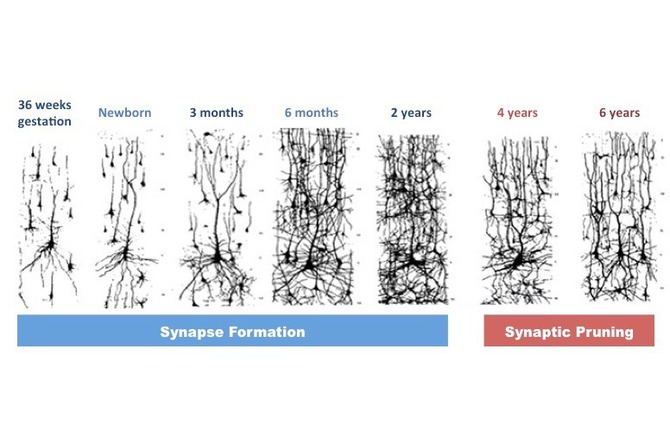
The reason our brain does this is that it needs to solidify the neural pathways/synapses that get used the most to make us most able to learn and recall information. The more we build and practice those connections, the more we remember and understand something.
This week’s strategy is a quick explanation that explains how to help connect new information your child is reading to content that they already know- helping them to understand it better and remember it!